
The Seatbelt Moment: Why AI Regulation Is the New Catalyst for Innovation
The era of unregulated AI is ending as global legislation begins to mirror the transformative safety mandates that revolutionized the automotive industry in the 1960s. While critics argue that the EU AI Act and similar frameworks will stifle innovation, history suggests that forced constraints actually drive superior engineering and public trust. This piece explores how AI is moving from a 'black box' novelty to a high-stakes public utility, requiring a shift in focus from raw power to auditable reliability. As the industry faces its 'seatbelt moment,' professionals must choose between the thrill of lawless experimentation and the necessary rigor of a regulated future. The transition will redefine competition, favoring those who embrace compliance as a hallmark of quality.
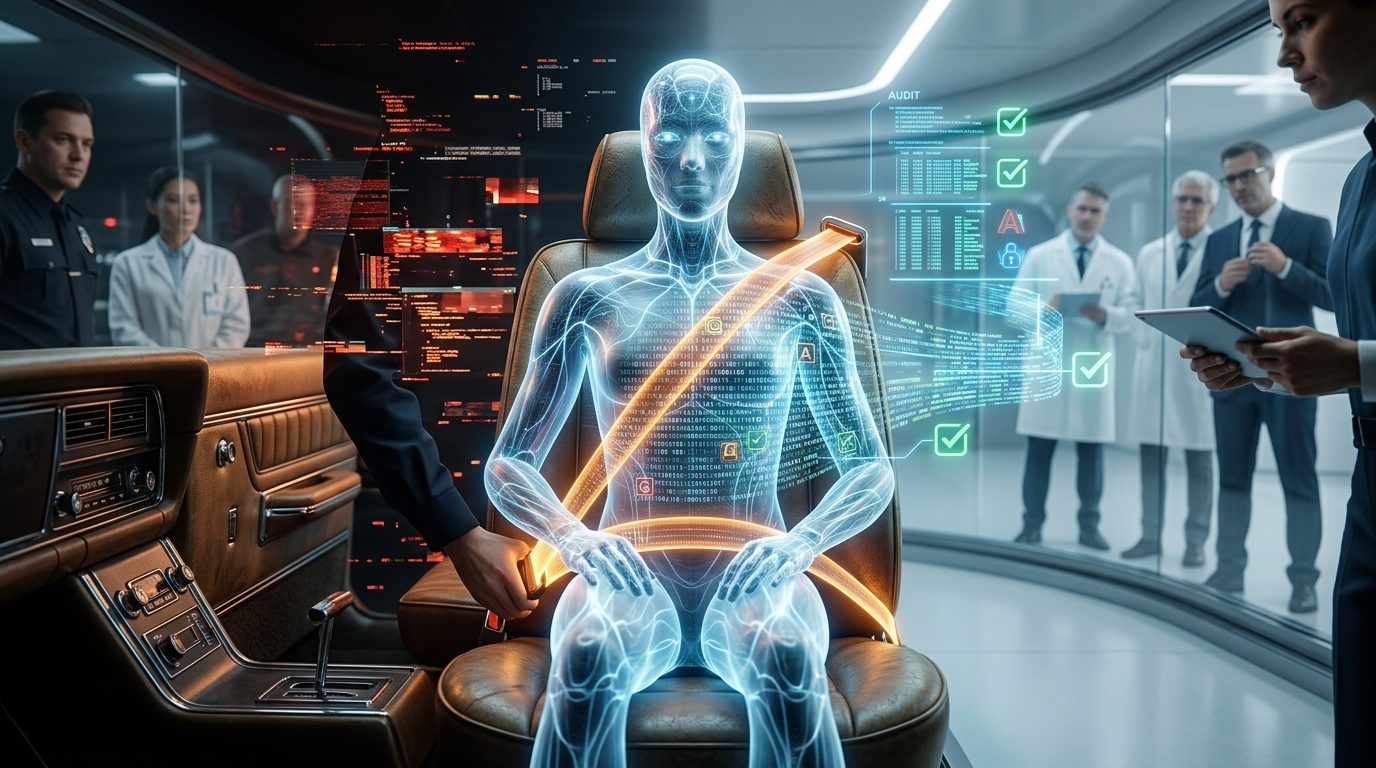
The silicon valley mantra of moving fast and breaking things has finally collided with the cold, hard reality of the legislative gavel. For a decade, artificial intelligence flourished in a digital Wild West, governed by little more than the vague ethical frameworks of the corporations building it. That era ended with the passing of the European Union AI Act and the proliferation of executive orders in the United States, marking a pivot point that mirrors the most transformative regulatory shift of the twentieth century: the taming of the automobile. Just as the internal combustion engine was eventually forced to trade raw horsepower for seatbelts and catalytic converters, AI is now being stripped of its lawless autonomy in exchange for a seat at the table of civilized infrastructure.
To understand where we are going, we must look at where we were in 1965. At that time, the American automotive industry was convinced that safety didn't sell. Manufacturers argued that legislating safety features like padded dashboards or collapsible steering columns would stifle innovation and drive up costs, making cars inaccessible to the masses. Then came Ralph Nader’s Unsafe at Any Speed and the subsequent National Traffic and Motor Vehicle Safety Act. The industry predicted a stifling of creativity, yet the opposite occurred. Regulation did not kill the car; it perfected it. It forced engineers to innovate within high-stakes constraints, leading to crumple zones, anti-lock brakes, and fuel injection systems that made vehicles faster, more efficient, and infinitely more reliable.
AI is currently undergoing its Nader moment. Critics of the EU AI Act and recent legislative pushes in California argue that stringent transparency requirements and risk-based classifications will hand the future to less-regulated adversaries. They claim that requiring developers to disclose their training data or submit high-risk models to third-party audits will slow the pace of deployment. However, this perspective ignores the fundamental truth of engineering history: innovation thrives under pressure. When the law demands that an algorithm be explainable, it forces a shift away from the black-box models that even their creators don't fully understand. It pushes the industry toward a higher form of technical maturity where reliability is prioritized over mere novelty.
The parallels between the two industries extend to the very definition of risk. The automotive industry eventually accepted that a car is not just a personal tool but a public liability. AI is transitioning into this same classification. When a large language model is used to screen resumes or a computer vision system is integrated into healthcare diagnostics, the stakes are no longer confined to a digital sandbox. They are physical, social, and economic. The emerging legislation specifically targets these high-risk applications, demanding a level of rigor that the industry has been reluctant to impose upon itself. Sam Altman, CEO of OpenAI, famously testified before Congress in 2023, stating that if this technology goes wrong, it can go quite wrong, effectively inviting the very oversight that critics now fear.
This shift will inevitably bifurcate the market. We are entering an era of industrial-grade AI, where the most valuable models will not be the largest or the most creative, but the most compliant and auditable. Professional creators and enterprise leaders who cling to the old ways of unvetted, experimental deployment will find themselves legally and ethically stranded. The winners of this new era will be those who view regulation as a blueprint for quality control rather than a hurdle to be cleared. Just as a Volvo’s reputation for safety became a premium selling point rather than a bureaucratic burden, the coming years will see the rise of certified AI—models that carry a seal of legislative approval, ensuring they are free from extreme bias and catastrophic failure modes.
The arrival of this regulated future is not a distant theory but a sequence of imminent legal triggers already appearing in the world's most influential jurisdictions. The Horizon Marker to watch is the first high-profile enforcement action or massive fine levied under the EU AI Act against a Tier-1 developer for failing to provide adequate documentation of their foundational model’s training data. This event will signal that the grace period for theoretical ethics is over and the era of mandatory compliance has begun, forcing every developer on the planet to choose between radical transparency or total market exclusion.
As we cross this threshold, every professional and creator must confront a Strategic Dilemma that will define their career in the coming decade. Will you continue to build your productivity and your business upon the unstable, albeit powerful, foundations of experimental and unregulated models, or are you prepared to sacrifice the raw, unbridled speed of the cutting edge for the slower, more rigorous certainty of a legislated and safety-first ecosystem? In a world where the law finally catches up to the machine, being the fastest may soon become the most dangerous way to play.
Discussion
Be the first to react.