
Australia's 350-Hectare AI Hub to Rival Coal Scale Power Demand
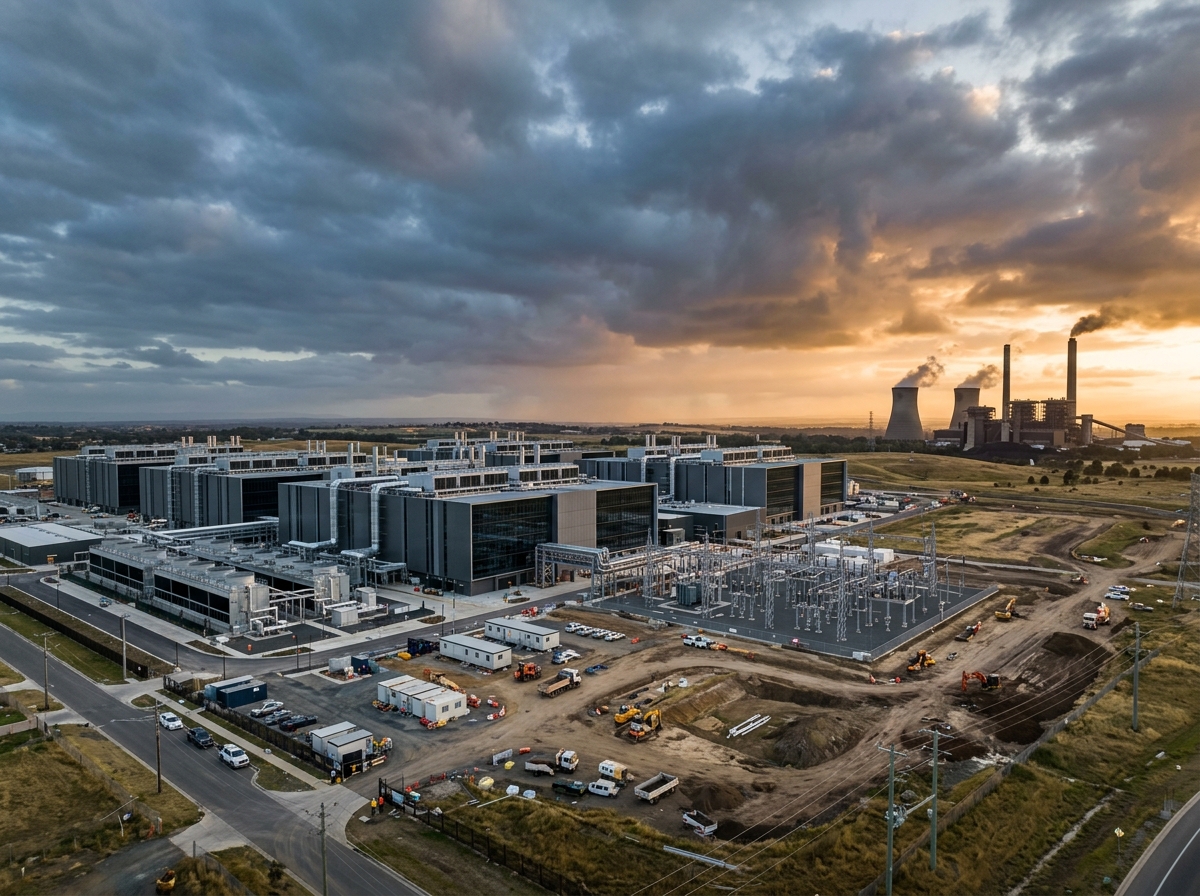
A massive proposal for a 350-hectare AI-focused data centre hub in Australia has emerged, signaling a shift toward 'AI factory' scale infrastructure. The project is notable for its projected power demand, which is expected to rival or exceed the output of Victoria’s largest coal-fired power station, Loy Yang A. Experts and proponents identify electricity availability as the primary bottleneck, overshadowing concerns regarding land or capital. This reflects a global trend where hyperscale AI campuses are becoming some of the world's most energy-intensive industrial sites. While specifics on the exact location and timeline remain undisclosed, the project highlights the significant strain AI workloads could place on Australia's transitioning energy grid. The debate centered on this development focuses on the tension between pursuing economic sovereign capability in AI and maintaining national energy security and transition goals. Affected stakeholders include the energy sector, tech industry, and regional communities where such massive facilities might be located.
Opening Insight
The digital economy is no longer weightless. For decades, the tech industry traded on the metaphor of the "Cloud"—a terminology that suggested something ethereal, hovering above the physical world without consuming its resources. That illusion is ending. As artificial intelligence transitions from experimental chatbots to the foundational engine of global industry, it is manifesting as a massive, heavy-industrial physical footprint.
In Australia, this shift is taking the form of a proposed 350-hectare AI hub. This is not merely another server farm; it is an "AI factory." The scale of energy required to power this facility doesn't just rival other tech projects; it rivals the total output of the nation’s largest coal-fired power stations. We are witnessing the birth of a new kind of infrastructure where compute power is treated with the same gravity as steel smelting or alumina refining.
The bottleneck for the future of intelligence is no longer software code or even the availability of silicon. It is the sheer volume of electrons available in the grid. Australia, traditionally an energy exporter built on the back of minerals and coal, now faces a pivot: will it become a global foundry for synthetic intelligence, and at what cost to its energy security?
What Actually Happened
Recent reports have detailed a massive proposal for a dedicated AI data centre hub in Australia, spanning approximately 350 hectares. To put that in perspective, this is a land area roughly equivalent to 170 Melbourne Cricket Grounds. The project is being framed as an "AI factory-style" campus, a term popularized by Nvidia CEO Jensen Huang to describe facilities where data goes in and intelligence comes out, processed by vast arrays of high-end GPUs.
The defining characteristic of this proposal is its power requirement. The facility is flagged for electricity demand on a scale comparable to, or even exceeding, the generation capacity of Victoria’s largest coal-fired power station, Loy Yang A. This represents a gigawatt-scale demand that fundamentally alters the profile of the Australian energy market.
While the exact location and final investment commitments remain under wraps, the proponents have identified that the primary hurdle is not securing the capital or the land. Rather, the development bottleneck is power availability. In the current landscape of hyperscale computing, the ability to secure a massive, stable connection to the high-voltage transmission grid is the ultimate competitive advantage. The project is currently positioned as a critical infrastructure vision, though precise timelines for breaking ground are not yet public.
Why It Matters Right Now
This proposal marks the moment AI moves from a "tech sector issue" to a "national infrastructure issue." Until now, data centres in Australia have been significant but manageable components of the grid. This project changes the calculus entirely. If one facility consumes as much power as a state-defining power plant produces, the stability of the entire National Electricity Market (NEM) becomes entangled with the AI industry.
We are currently in the middle of an energy transition. Australia is attempting to retire its coal fleet and replace it with renewables and storage. Integrating a consumer of this magnitude—one with a flat, persistent, and massive demand profile—creates an immediate tension. Does the grid build out to support the AI factory, or does the AI factory’s demand risk crowding out the needs of residential and existing industrial users?
Furthermore, this represents a new form of economic sovereign capability. By hosting an "AI factory" of this scale, Australia would potentially move from being a consumer of AI models developed in Northern California to being a primary site for the creation of those models. The economic gravity of such a hub would attract peripheral industries, from liquid cooling specialists to specialized semiconductor maintenance firms, potentially creating a "silicon belt" in what may have previously been "rust belt" or agricultural regions.
Wider Context
Globally, we are seeing the emergence of the "gigawatt campus." In the United States, companies like Microsoft, Google, and Amazon are increasingly seeking sites where they can co-locate data centres with dedicated nuclear plants or massive solar arrays. The Australian proposal is a local manifestation of this planetary trend.
Historically, data centres focused on "latency"—being close to the user to ensure fast load times. In the era of AI training, latency is less important than "energy density." Training a Large Language Model (LLM) takes months of continuous, high-intensity compute. The facility doesn't need to be near a city; it needs to be near a massive power source. This is why we are seeing a shift in focus toward regions with robust, if older, grid infrastructure.
In the Australian context, this follows a period of "post-industrial" anxiety. As traditional manufacturing and heavy industry have declined, there has been a search for the "next big thing." Data centres were once seen as a clean, quiet alternative. However, the sheer scale of the 350-hectare proposal suggests that the AI era will be just as resource-intensive as the industrial era it replaces. It is simply consuming electricity instead of iron ore or bauxite.
Expert-Level Commentary
The primary challenge here is the "synchronous" nature of the demand. Unlike residential electricity use, which peaks in the evening and drops overnight, an AI factory runs at 100% capacity, 24/7. This is known as a high "load factor."
For grid operators, this is both a blessing and a curse. It provides a steady, predictable customer, but it leaves zero margin for error. If the AI hub is drawing a gigawatt and a major transmission line goes down or renewable generation drops, the resulting instability is magnified. Commentary around the proposal suggests that for a project of this scale to succeed, it cannot simply plug into the existing grid. It will likely require "behind-the-meter" solutions—dedicated renewable farms or massive battery installations that can buffer the facility from the wider network.
There is also the question of cooling. High-density GPU clusters generate immense heat. A 350-hectare site suggests that a significant portion of the land may be dedicated not just to the server halls, but to the industrial-scale cooling infrastructure required to keep the processors from melting. In a water-scarce continent like Australia, the choice between air cooling (which uses more power) and liquid/evaporative cooling (which uses more water) will be a critical environmental and operational pivot point.
Finally, there is the "Compute-to-GDP" argument. Proponents will argue that the value generated by this AI hub justifies the energy consumption. Skeptics will point out that while a coal mine or a factory employs thousands of people, a highly automated AI data centre—even one of this size—may only require a small fraction of that workforce once construction is complete. The debate will center on whether the digital output is worth the physical input.
Forward Look
Looking ahead, the success of this 350-hectare hub will depend on its "social license" to consume energy. As electricity prices remain a sensitive political issue in Australia, the proponents will likely need to prove that they are bringing their own energy to the table. We should expect to see future announcements linked to this project involving large-scale solar, wind, or potentially long-term agreements with existing generators that could delay the retirement of older plants to ensure "firming" of the power supply.
We may also see a regional competition emerge. If the location remains undisclosed, states will likely vie for the project, viewing it as a "prestige" infrastructure asset. However, the winning region will need to have a grid that can handle the massive "step-change" in demand that a project of this scale represents.
If this project moves from proposal to reality, it will set a new benchmark for Australian infrastructure. It will signal that Australia is no longer just a "quarry for the world" but intends to be a "data furnace" for the global AI economy. The 350-hectare footprint is just the beginning; if the AI transition continues at its current pace, we may see multiple such hubs appearing across the continent, clustered around the strongest nodes of the national grid.
Closing Insight
The proposal for a coal-scale AI hub forces us to confront the physical reality of the digital age. We are exiting the era of "green bits" and entering the era of "heavy compute."
This 350-hectare project is a bellwether. It suggests that the future of artificial intelligence is not just about algorithms; it is about real estate, copper, and kilovolts. As the project develops, the central question will not be whether we can build the AI, but whether our energy grids can sustain it without compromising the needs of the society that the AI is supposed to serve. The "AI factory" is no longer a metaphor—it is a massive, power-hungry industrial reality coming to the Australian landscape. High-performance computing has finally met the hard limits of the physical world.