
ARIA Bans AI Music: Australia Sets a Human-Only Standard for Charts
The Australian Recording Industry Association (ARIA) has introduced landmark changes to its charts code, effective August 2026, banning tracks that are wholly or largely created by generative AI. To qualify for ARIA charts or awards, recordings must now be "substantially human made," requiring human authorship, lead vocals, and primary instrumentation. While AI assistance is permitted in a minor capacity, the human creative element must remain dominant. ARIA has also granted itself new powers to audit recordings, adjust chart positions, and revoke awards to combat AI-generated content and stream manipulation. This move sets a significant precedent in the global music industry, prioritizing human agency and economic protection for artists amidst growing pressure from AI developers and infrastructure expansions. The debate now centers on the technical difficulty of verifying human output and the philosophical definition of creativity in a digital age.
Opening Insight
The definition of a "recording artist" is undergoing its most rigorous legal and commercial stress test in the history of the medium. For decades, technology has served as a silent partner in the recording studio—from the advent of multi-track recording to the pitch-correction software that defined the sound of the 2000s. But the rise of generative AI represents a departure from these tools. It is not an instrument; it is a surrogate.
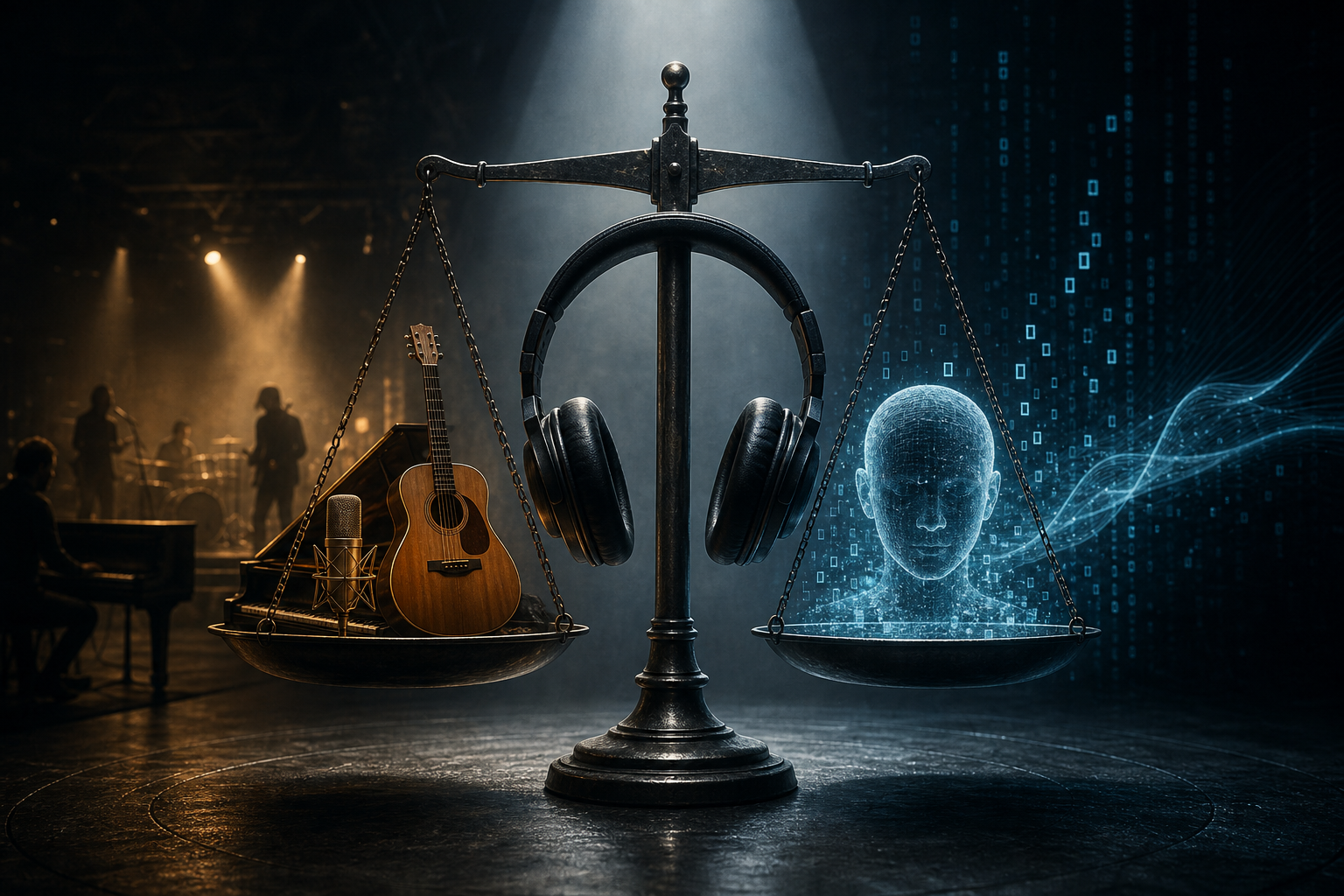
By banning wholly or largely AI-generated tracks from its official charts and awards, the Australian Recording Industry Association (ARIA) has drawn a line in the sand. This is not merely a bureaucratic update to a rulebook; it is a philosophical declaration. ARIA is asserting that "merit" in the music industry is intrinsically tied to human biology and human agency. In an era where a machine can synthesize a chart-topping melody in seconds, Australia has decided that the charts must remain a leaderboard for people, not processors.
What Actually Happened
Effective with the chart dated 31 August 2026, ARIA has formally updated its charts code to exclude recordings that lack a "substantially human" foundation. The new regulations explicitly bar tracks that are wholly or largely created by generative AI from appearing on the weekly ARIA charts or qualifying for the annual ARIA Awards.
The criteria for eligibility are now anchored in three pillars of human contribution: songwriting, lead vocals, and primary instrumentation. To qualify for commercial recognition, a recording must be driven by human creative output in these core areas. While AI-assisted songs—those using the technology for mixing, mastering, or minor textural elements—remain eligible, the human contribution must remain the dominant force.
Furthermore, ARIA has significantly bolstered its enforcement mandate. The association now possesses the authority to remove ineligible tracks, adjust chart positions retrospectively, and revoke awards if it is determined that a recording breached the new code. These powers also extend to "stream-manipulation," a growing concern where AI bots are used to inflate play counts, creating a false sense of popularity to trick chart algorithms.
Why It Matters Right Now
This move comes at a moment of extreme tension between the creative industries and AI developers. As the Australian Treasury flags a potentially slow uptake of AI across the broader economy, the music industry is moving in the opposite direction, attempting to slow down an integration that many fear will devalue human labor.
For Australian artists, the stakes are existential. If a "faceless" AI track, generated by a prompt and owned by a software corporation, can occupy a chart position, it displaces a human artist who relies on that chart position for festival bookings, radio airplay, and government grants. By enforcing these rules, ARIA is protecting the economic viability of the human artist.
It also signals a shift in how we define "authenticity." The industry is moving from a "don't ask, don't tell" phase regarding AI tools to a mandated disclosure environment. Labels and independent artists must now be prepared to prove the provenance of their work. The "substantially human made" clause places the burden of proof on the creator, effectively turning the ARIA charts into a protected biological reserve.
Wider Context
The ARIA decision does not exist in a vacuum. It coincides with a broader national push in Australia to regulate the footprint of artificial intelligence. National Cabinet recently agreed on AI laws aimed at addressing the infrastructure and energy impacts of data centers, reflecting a government-wide recognition that AI’s growth requires strict guardrails.
Globally, the music industry is fractured on this issue. Some territories are exploring "AI categories" for awards, while others are attempting to ban the technology entirely. Australia’s approach is a middle path: it permits the tool but denies it the podium.
This regulatory shift also reflects growing concerns regarding data sovereignty. With AI companies looking to leverage Australian data centers to train models, the creative community is increasingly wary of their work being used as "training data" to eventually replace them. The ARIA ban is a defensive maneuver against the commodification of the human voice and the regional nuances of the Australian sound.
Expert-Level Commentary
The primary challenge for ARIA will be technical verification. As generative AI becomes more sophisticated, the "uncanny valley" of music is closing. Distinguishing between a human-played guitar riff and one synthesized by a high-fidelity model is becoming nearly impossible for the human ear. ARIA’s new enforcement powers suggest they will rely on forensic audio analysis or metadata audits to police the charts.
However, the phrase "substantially human made" is inherently subjective. At what percentage does a human-written song become "largely" AI-generated if the vocals are synthesized? The industry is likely to see "gray market" productions where AI is used to ghostwrite melodies that are then "performed" by humans to circumvent the rules.
There is also the risk of stifling innovation. Electronic music has always pushed the boundaries of what constitutes "performance." By mandating "primary instruments" be human-played, ARIA risks alienating sub-genres that rely on algorithmic composition and digital sequencing—technologies that predated the current AI boom but may now fall under the same regulatory umbrella.
Forward Look
Looking toward 2027 and beyond, we should expect a "verification industry" to emerge. Labels will likely require "Human-Made" certifications before distributing tracks, similar to how organic food is certified. This will create a two-tiered market: the "Validated Human" charts (ARIA) and the "Open-Source" charts (streaming platform playlists where AI and humans compete without restriction).
We may also see legal challenges to ARIA’s enforcement powers. If a major label’s star artist uses AI for a chart-topping hook and ARIA attempts to revoke an award, the definition of "substantially human" will be litigated in the courts, not just in the boardroom.
The influence of these rules will extend beyond music. If ARIA is successful in maintaining the integrity of its charts, other creative bodies—in literature, film, and journalism—will likely adopt similar "biological preference" clauses. The Australian recording industry is currently the laboratory for a much larger experiment: can we legislate the value of the human soul in a digital economy?
Closing Insight
The ARIA ban is an act of institutional bravery, but it is also a desperate one. It acknowledges a truth that the tech industry often ignores: music is not just "content" to be optimized; it is a record of human experience. By barring the machines from the podium, ARIA is reminding us that we don't listen to music just to hear sound—we listen to hear each other. The question remains whether the wall they have built is high enough to withstand the coming flood of synthetic creativity, or if the definition of "human" will simply be stretched until the word loses its meaning. Human-led creativity has been granted a reprieve in Australia, but the battle for the charts has only just begun.