
DNA as Code: Stanford’s Evo 2 AI Designs Bespoke Viruses
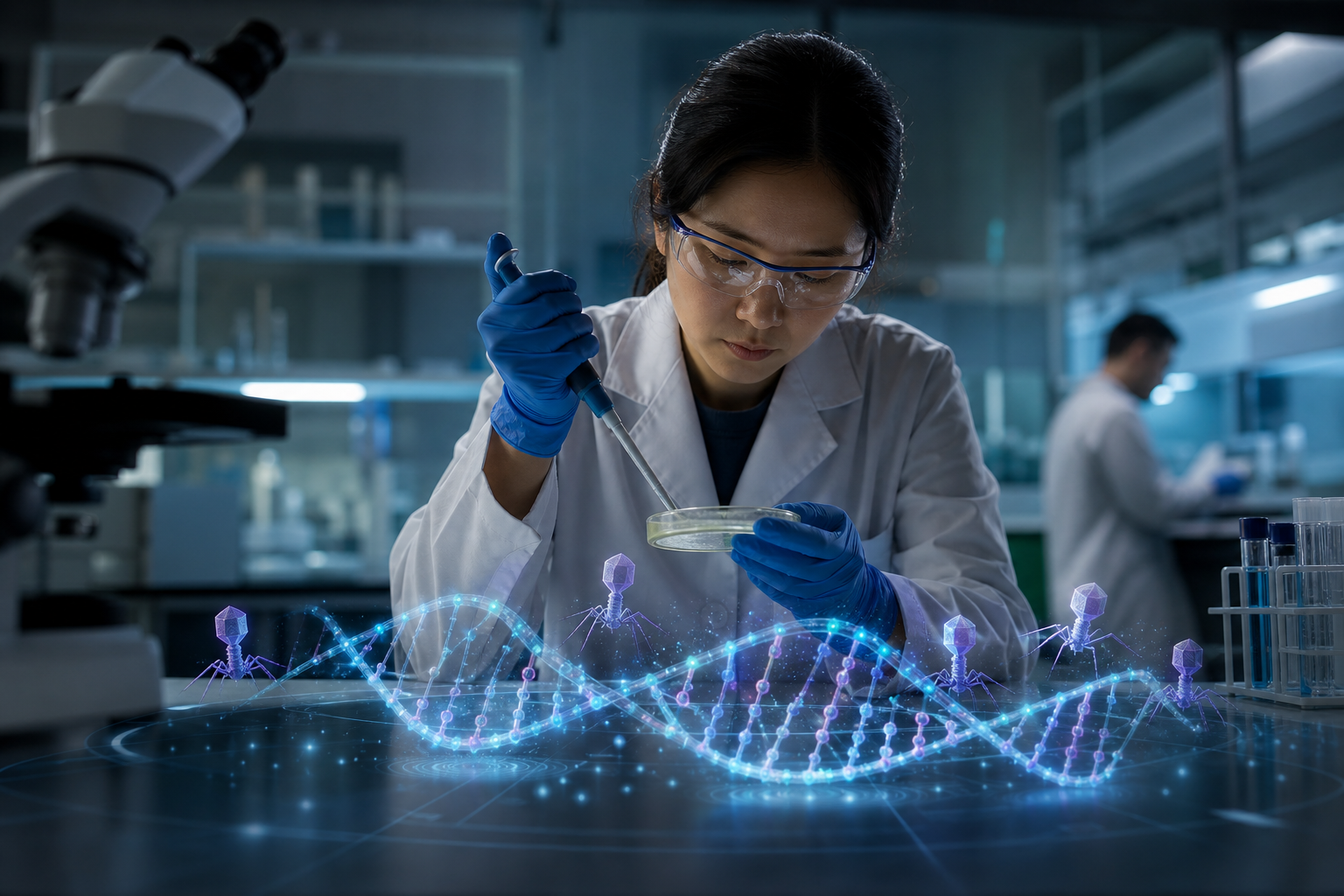
Researchers at Stanford University have achieved a landmark breakthrough in generative AI with the Evo 2 model, which has successfully designed functional phages—viruses that target and kill bacteria—specifically for E. coli. Unlike previous AI applications focused on text or images, Evo 2 treats the genome as a programmable language, generating entirely new biological sequences that do not exist in nature. This shift from predictive biology (understanding what exists) to prescriptive biology (creating what is needed) offers a potential solution to the global antimicrobial resistance crisis. While the technology promises bespoke, rapid-response medical treatments, it also triggers intense debate regarding biosecurity and the 'dual-use' risk of AI-driven biological design. The achievement marks a pivotal moment where AI transitions from a digital assistant to a biological architect, fundamentally altering our relationship with the code of life.
Opening Insight
The boundary between biological reality and digital simulation has officially dissolved. We are no longer merely using artificial intelligence to catalog the natural world or predict its behaviors; we are using it to draft new biological entities from scratch.
Stanford’s Evo 2 model represents a fundamental shift in the AI narrative. While the public remains preoccupied with chatbots that hallucinate poetry or image generators that struggle with human anatomy, the scientific frontier has moved into the "DNA as code" era. By successfully generating phages—viruses that hunt and kill specific bacteria—against E. coli, Evo 2 has demonstrated that generative AI can master the most complex programming language in existence: the four-letter alphabet of life.
This is not a "large language model" in the sense we’ve come to understand through GPT-4. It is a large biological model. It treats the genome not as a mystery to be decoded by humans, but as a dataset to be optimized by machines. The implications for medicine, biosecurity, and the very definition of "natural" selection are staggering.
What Actually Happened
Researchers at Stanford University have reported a significant breakthrough involving their Evo 2 model, a generative AI architecture designed specifically for biological sequences. The model successfully generated phages—viruses that naturally infect and kill bacteria—tailored to target Escherichia coli (E. coli).
Unlike traditional drug discovery, which often involves screening thousands of existing compounds to see what "sticks," Evo 2 operates on a generative principle. It was trained on massive genomic datasets, allowing it to understand the underlying "grammar" of DNA and protein structures. Using this training, it synthesized entirely new phage designs that do not exist in nature but are functionally capable of neutralizing their bacterial targets.
Phages are notoriously difficult to work with because they are highly specific; a phage that kills one strain of E. coli might be harmless to another. The ability of Evo 2 to design these entities from the ground up suggests a level of precision that human researchers, even with advanced laboratory tools, find difficult to achieve manually. The study marks a transition from AI as a diagnostic assistant to AI as a biological architect.
Why It Matters Right Now
The emergence of Evo 2 occurs against the backdrop of a looming global health crisis: antimicrobial resistance (AMR). As common bacteria evolve to survive our current catalog of antibiotics, the "superbug" threat grows. Traditional pharmaceutical pipelines have largely stalled in producing new classes of antibiotics, leaving a vacuum in our defensive capabilities.
Phage therapy has long been discussed as a potential successor to antibiotics, but its implementation has been hindered by the difficulty of finding or engineering the "perfect" phage for a specific infection. Evo 2 changes the math. If AI can generate bespoke phages in a matter of hours or days, we move from a world of "one-size-fits-all" medicine to a world of rapid-response biological engineering.
Furthermore, this development validates the "Generative Biology" thesis. It proves that the transformer architectures—the same technology powering ChatGPT—are transferrable to the physical sciences. If you can predict the next word in a sentence, you can theoretically predict the next nucleotide in a gene sequence. Evo 2 is the proof of concept that the "LLM moment" for biology has arrived.
Wider Context
To understand Evo 2, we must look at the trajectory of AI in science over the last five years. The journey began in earnest with DeepMind’s AlphaFold, which solved the 50-year-old "protein folding problem." AlphaFold could predict the 3D shape of a protein based on its amino acid sequence. It was a monumental achievement in prediction.
Evo 2 represents the next logical step: creation.
We are moving away from descriptive biology—where we observe what nature has provided—into prescriptive biology. This sits within a broader movement where AI is being integrated into synthetic biology, materials science, and climate engineering. However, biological design carries a unique set of risks and ethical considerations that text and image generation do not.
While a hallucinating chatbot might provide a wrong answer to a history question, a "hallucinating" biological model could, in theory, design a sequence with unintended ecological consequences. The scientific community is currently debating how to build "guardrails" for biological models that are as robust as the models themselves.
Expert-Level Commentary
The sophistication of Evo 2 lies in its ability to handle long-range dependencies in genomic data. Genomes are not just linear strings of information; they involve complex interactions where a sequence at one end of a DNA strand influences something at the far end. Most previous models struggled with this scale. Evo 2’s architecture appears designed to maintain "context" across vast stretches of genetic code, similar to how a sophisticated LLM maintains the plot of a long novel.
From a technical standpoint, the success against E. coli is significant because E. coli is the "lab rat" of the microbial world. It is the baseline. If the model can master phages for E. coli, the leap to more pathogenic bacteria—like Staphylococcus aureus (MRSA) or Pseudomonas aeruginosa—is a matter of scaling and data, not a fundamental technological hurdle.
There is also the matter of "orphan" sequences. Much of the genomic data we have collected over the decades consists of sequences whose functions we don't fully understand. Models like Evo 2 don't necessarily need to understand the "why" in human terms; they identify the patterns that lead to viable biological outcomes. This "black box" of biological design is both the model's greatest strength and its most controversial attribute.
Forward Look
In the short term, we should expect to see the Stanford team and their peers move toward more complex targets. The design of phages for multi-drug resistant pathogens will be the immediate clinical priority. We may also see the first human trials of AI-generated biological entities within the decade, depending on how regulatory bodies like the FDA adapt to this technology.
In the medium term, the focus will likely shift to "multi-modal" biological AI. Imagine a system where you input a specific bacterial genome, and the AI outputs not just the genetic sequence for a phage, but also the instructions for a 3D bio-printer to manufacture it. This would decentralize drug production, potentially allowing hospitals to print their own custom treatments on-site.
However, the "dual-use" dilemma looms large. The same technology that can design a phage to save a life could, in the wrong hands, be used to design or enhance a pathogen. The conversation around "open-sourcing" these models is fraught. While open science accelerates discovery, it also lowers the barrier to entry for biological subversion. The next two years will likely see a push for international treaties or "biological alignment" protocols to manage these risks.
Closing Insight
The success of Stanford’s Evo 2 signifies that we have entered the age of Biological Programming. We are treating the code of life with the same iterative fluidity that we treat software.
This is a profound shift in the human condition. For millennia, we were subject to the whims of evolution and the slow pace of natural selection. Then, we learned to manipulate biology through selective breeding and, later, CRISPR gene editing. Now, we are delegating the design process itself to non-human intelligence.
Evo 2 is not just a tool for killing E. coli. It is a herald of a future where the distinction between "grown" and "built" no longer exists. As we gain the power to draft the blueprints of life, our primary challenge will not be technical, but philosophical: just because we can program the biosphere, does it mean we should? The answer will define the next century of our species.