
Governments Step Up Biodefense AI Regulation After Expert Warnings
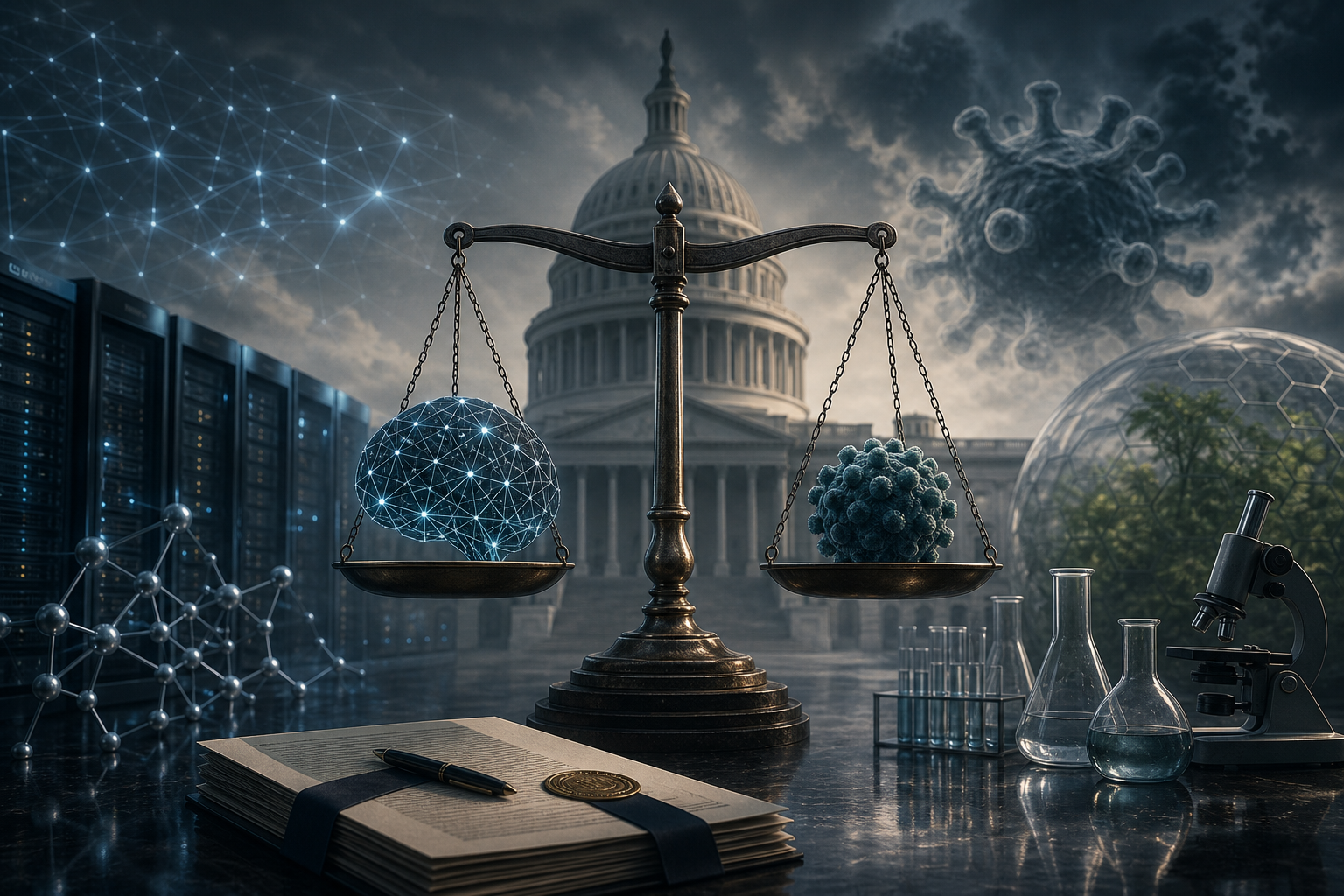
Governments are pivoting toward aggressive oversight of artificial intelligence, specifically targeting the intersection of large-scale models and biological security. Following warnings from AI safety researchers that frontier models could lower the technical barriers to designing biological weapons, U.S. policymakers are discussing draft legislation that would mandate pre-release reviews and periodic audits for high-risk AI systems. This moves the industry from a regime of voluntary safety commitments to one of enforceable federal regulation. The move impacts major AI developers, the open-source community, and the broader biotechnology sector. The early debate centers on a tension between the need to prevent "black swan" biosecurity events and the risk of stifling innovation or creating regulatory monopolies. This shift signals a new era of proactive governance where AI is treated with the same level of scrutiny as nuclear technology.
Opening Insight
The intersection of artificial intelligence and biotechnology has moved from the realm of speculative science fiction to the center of national security planning. For years, the narrative around AI risks focused on data privacy or job displacement. That focus is shifting. Governments are now awakening to a "dual-use" dilemma that is far more visceral: the possibility that large-scale AI models could democratize the creation of biological weapons.
The barrier to entry for high-end biological research has historically been protected by "tacit knowledge"—the complex, unwritten expertise acquired through years of lab work. Recent advancements suggests that AI is beginning to bridge that gap. By synthesizing vast datasets and providing step-by-step instructions for pathogen enhancement, these models could theoretically allow individuals without specialized training to bypass traditional safeguards.
This is no longer a theoretical debate between academics. It is the catalyst for a fundamental shift in how governments intend to regulate the private sector. We are witnessing the end of the "move fast and break things" era for AI developers, replaced by a regime of pre-release reviews and mandatory audits. The stakes have transcended digital security and entered the domain of existential biosecurity.
What Actually Happened
In a series of high-level policy discussions and legislative drafts characterized by an unusual sense of urgency, U.S. policymakers have moved to formalize what were previously voluntary "safety commitments" from major AI labs. The central thrust of this movement is a requirement for certain high-risk AI models to undergo rigorous pre-release reviews and periodic auditing.
The catalyst for this legislative push is a chorus of warnings from AI safety researchers and biosecurity experts. These experts contend that large models—particularly those trained on biological data or those with sophisticated reasoning capabilities—could materially assist in the development of biological threats. This includes everything from optimizing the virulence of a pathogen to providing instruction on how to acquire precursors without triggering law enforcement red flags.
Currently, the world’s leading AI firms, such as OpenAI, Google DeepMind, and Anthropic, operate under a patchwork of self-imposed safety protocols. While these companies have performed internal "red teaming" to identify biosecurity risks, the new proposed measures would transition this oversight from the corporate boardroom to federal regulators. The draft legislation aims to establish enforceable standards for model weights, data curation, and the "jailbreaking" resistance of systems that interact with biological sequences.
The discussions also highlight a growing concern over open-source models. While closed models can be updated or revoked if a risk is identified, open-source weights are permanent. This has led to intense debate over whether certain "frontier" biological capabilities must be restricted to sanctioned, monitored environments only.
Why It Matters Right Now
The timing of this regulatory pivot is dictated by the velocity of AI development. We are seeing a convergence of three factors that make the status quo untenable.
First, the scale of compute used to train models is doubling at an unprecedented rate. Each iteration of GPT, Claude, or Gemini possesses inherently more "emergent" capabilities than its predecessor. A model that was safe six months ago might, through fine-tuning or new plugin architectures, suddenly become a potent tool for biological design.
Second, the biotechnology industry itself is becoming increasingly digitized. Lab automation, DNA synthesis-on-demand, and protein-folding models like AlphaFold have created a digital ecosystem that AI can navigate. When an AI can not only "think" about biology but also interface with automated systems to "do" biology, the risk profile changes fundamentally.
Third, there is a mounting realization that the "hallucination" problem in AI is an insufficient defense. Critics once argued that AI-generated biological instructions were too inaccurate to be dangerous. However, recent testing suggests that frontier models are becoming increasingly precise and can even correct their own errors when prompted, closing the gap between a "dangerous idea" and a "viable protocol."
This matters to the public because it represents the first major "hard" regulatory ceiling on AI. It signals that the era of permissionless innovation is being curtailed by the state in the name of survival.
Wider Context
To understand the gravity of these biosecurity measures, one must look at them within the broader landscape of "AI Safety" and geopolitical competition. This is not happening in a vacuum. The U.S. and its allies are engaged in a strategic race to set the standards for global AI governance before a "race to the bottom" occurs.
Historically, the regulation of powerful technologies followed a predictable pattern: innovation occurred, a disaster happened, and then laws were written. With biosecurity, the goal is "proactive governance." This is a departure from the traditional legal framework. It borrows more from the regulation of nuclear materials than it does from the regulation of software.
There is also the "Open vs. Closed" ideological war. Advocates of open-source AI argue that transparency is the best defense against threats—that having "more eyes" on the code allows for faster patching of vulnerabilities. Security hawks, however, argue that you cannot "patch" a biological outbreak. They maintain that the sheer destructive potential of a custom-engineered pathogen necessitates a "gatekeeper" model of distribution.
Furthermore, these regulations reflect a shift in the definition of "National Security." In the 20th century, security was measured by missiles and borders. In the 21st, it is increasingly measured by the control of information and the ability to prevent "black swan" events generated by small, non-state actors using powerful computational tools.
Expert-Level Commentary
The expert discourse surrounding these regulations is divided between those who believe the measures are overdue and those who fear they will stifle the very innovation needed to defend against biological threats.
Proponents, including many who have testified before Senate committees, argue that the "asymmetry" of biosecurity is the core problem. It is far easier to design a pathogen to cause harm than it is to design a vaccine or a universal countermeasure. By restricting the AI tools that could assist in the design phase, we buy time for the "defensive" side of biotech to catch up. They argue that pre-release auditing is the only way to catch "scaffolded" risks—where an AI model exhibits dangerous behavior only when paired with specific external tools.
On the other side, some experts caution against "regulatory capture." They worry that by requiring expensive, complex audits and pre-release reviews, the government will inadvertently hand a monopoly to the few companies rich enough to comply. This could slow down the use of AI for beneficial biological research—such as curing cancer or preventing the next natural pandemic.
There is also a technical debate about "model evaluation." Experts point out that we currently lack a standardized, scientific way to measure exactly how "dangerous" a model is. If the law requires an audit but the "thermometer" for risk hasn't been invented yet, we risk a regime of arbitrary enforcement guided by political optics rather than empirical safety.
Forward Look
In the coming months, we should expect the "draft" phase of these regulations to solidify into concrete policy. The first indicator of success will be whether these requirements are integrated into international agreements. Since AI models can be trained anywhere with enough GPUs, U.S.-only regulation would simply drive high-risk development to jurisdictions with fewer rules.
We will likely see the emergence of a new "Auditing Industry." Just as the Big Four accounting firms oversee global finance, new specialized firms—staffed by a mix of biologists and machine learning engineers—will rise to provide the mandatory safety certifications required by law. These "AI Notaries" will become the most powerful middlemen in the tech ecosystem.
Technically, we should expect a surge in "Safety-by-Design" research. Lab leaders will attempt to build "un-learnable" datasets—biological information that is curated in such a way that it can train a model on medicine without teaching it about toxicity. Whether this kind of surgical removal of information is actually possible remains one of the greatest technical challenges in the field.
Finally, the tension between national security and open-source innovation will reach a breaking point. We may see the creation of "tiered access" models, where the most powerful versions of an AI are kept behind a state-monitored firewall, while the public only interacts with "lobotomized" versions that have been stripped of high-level biological reasoning.
Closing Insight
The move to regulate AI through the lens of biodefense marks a critical maturity milestone for the industry. It is an admission that code is no longer just speech; it is a catalyst for physical transformations in the real world.
If the digital world and the biological world are becoming one, then the laws governing software must inevitably become as stringent as the laws governing medicine. This is a trade-off. We are choosing to sacrifice some of the speed of innovation for a greater margin of safety. Whether this regulatory "braking system" will be enough to prevent a catastrophe—or whether it will simply slow down our ability to find the cure—is the gamble that policymakers are now taking.
The era of trusting "safety through obscurity" or "safety through corporate goodwill" is over. The era of the monitored model has begun.