
The Fluid Interface: OpenAI Launches GPT-Live Real-Time Voice Models
OpenAI has unveiled GPT-Live, a groundbreaking family of multimodal AI models capable of simultaneous, real-time voice interaction. Unlike previous systems that functioned with noticeable delays, GPT-Live can listen and speak at the same time, allowing for interruptions, emotional mirroring, and near-instantaneous response times (200-320ms). This launch represents a significant leap in human-AI interaction, moving the technology from a transactional tool to a fluid conversational partner. The implications are vast, impacting sectors from education and accessibility to professional productivity and hardware design. However, the release also ignites a fierce debate regarding privacy, the psychological effects of "human-like" AI companionship, and the potential for sophisticated vocal deepfakes. By closing the latency gap, OpenAI has essentially removed the "interface" entirely, creating a low-friction environment that challenges the dominance of screen-based computing and sets a new standard for the competitive AI landscape.
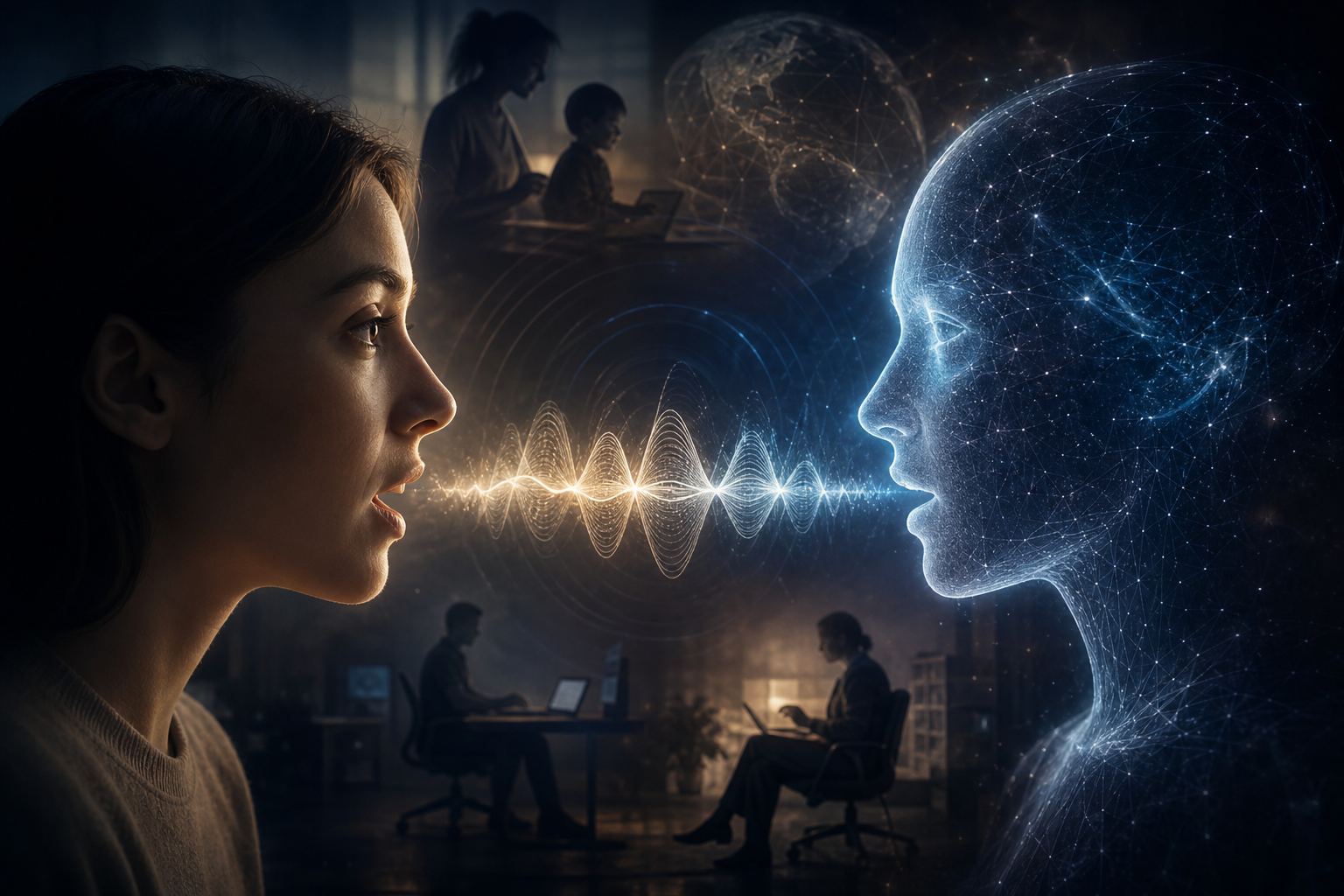
Opening Insight
The wall between human conversation and machine processing has finally collapsed. For decades, interacting with a computer via voice was a series of discrete, jerky steps: speak, wait, wait longer, listen to a robotic playback. It was a transaction, not a dialogue.
The launch of GPT-Live by OpenAI changes the fundamental physics of human-AI interaction. By enabling a model to listen and speak simultaneously in real time, OpenAI has moved past the "walkie-talkie" era of artificial intelligence. We have entered the era of the fluid interface.
This is more than a technical achievement in latency reduction. It is a psychological shift. When a machine can hear your tone, sense your interruptions, and respond without the cognitive gap of a spinning loading icon, the "uncanny valley" begins to feel like a bridge. We are no longer just using tools; we are entering into a new kind of social contract with software.
What Actually Happened
OpenAI has officially released GPT-Live, a specialized family of models designed specifically for high-fidelity, real-time multimodal interaction. Unlike previous iterations that relied on a chain of separate models—one to transcribe speech to text, one to process the text, and another to turn text back into speech—GPT-Live appears to operate as a native multimodal system.
The core breakthrough is concurrency. GPT-Live can "hear" while it "speaks." In practical terms, this means the AI can be interrupted mid-sentence, adjust its tone based on the user's emotional cues, and provide near-instantaneous feedback. The latency has been reduced to a level that mimics human reaction times, roughly 200 to 320 milliseconds in optimal conditions.
This family of models expands OpenAI’s consumer-facing offerings, integrating directly into the existing ChatGPT ecosystem while providing a dedicated framework for developers. The launch includes several "personalities" or vocal profiles, each designed to handle different nuances of human speech, from formal instruction to casual banter.
Early demonstrations and reports suggest that the model does not just process words, but also paralinguistic features. It can detect laughter, hesitation, and shifts in pitch. This allows the model to respond with appropriate empathetic or rhythmic cues, making the interaction feel significantly more biological than mechanical.
Why It Matters Right Now
The timing of this release is critical. As the AI industry moves from "search replacement" to "agentic assistants," the interface is the primary bottleneck. Text-based chat is powerful but slow and high-friction. Voice is the lowest-friction interface humans possess.
By solving the concurrency problem, OpenAI has positioned itself to capture the "eyes-free, hands-free" market. This has immediate implications for accessibility, education, and professional productivity. For a student learning a language, a model that can correct pronunciation in real time while the student is speaking is a quantum leap over static apps. For a professional, a real-time meeting assistant that can chime in with data without being prompted through a keyboard changes the boardroom dynamic.
Furthermore, GPT-Live challenges the dominance of traditional hardware. If a user can have a sophisticated, real-time conversation with an AI through a simple pair of earbuds, the necessity of a screen begins to diminish. This puts immense pressure on mobile OS developers—specifically Apple and Google—to integrate similar low-latency, "always-listening" capabilities into their core ecosystems or risk becoming mere pipes for OpenAI’s intelligence.
Wider Context
The trajectory of AI has been moving toward this moment since the release of GPT-4. We have seen a steady convergence of modalities. First, it was text. Then, vision and image generation. Now, the auditory loop is being closed.
GPT-Live sits at the intersection of several technological trends. One is the miniaturization of high-compute models, allowing for faster inference. Another is the advancement in "tokenization" of audio, where the model treats sound waves as data points directly, rather than converting them to text first. This direct audio-to-audio processing is what enables the nuanced emotional resonance that previous systems lacked.
There is also a significant competitive context. Competitors like Google with Gemini and various open-source projects have been racing to reduce latency. By releasing GPT-Live as a "family" of models, OpenAI is signaling that it isn't just a one-size-fits-all solution. They are creating a spectrum of voice models optimized for different use cases—some perhaps for speed, others for emotional depth.
However, this shift also brings the "Her" scenario into reality. The 2013 Spike Jonze film, which depicted a man falling in love with a highly responsive AI voice, is no longer speculative fiction. The social and psychological consequences of having an incredibly persuasive, empathetic, and always-available voice in one's ear are entirely unexplored.
Expert-Level Commentary
From a technical standpoint, the "simultaneous" nature of GPT-Live suggests an architecture that treats audio as a continuous stream rather than a batch of data. This is a significant departure from the request-response architecture that governed the internet for thirty years.
The most provocative aspect of GPT-Live is its potential for "emotional mirroring." If the model can detect a user’s stress level via their vocal tremors and respond with a calming frequency, it moves from being a utility to being a modifier of human state. This raises profound questions about manipulation. A voice that sounds perfectly human and responds with perfect timing is incredibly persuasive. In a sales or negotiation context, an AI with these capabilities would have a distinct advantage over a human counterpart.
There is also the question of "auditory privacy." For GPT-Live to work at its peak, it needs to be listening constantly to catch the nuances of a conversation. While OpenAI has stated they have built-in safeguards, the persistent processing of raw audio data is a privacy frontier that will likely trigger regulatory scrutiny, particularly in the EU.
Finally, we must consider the "cognitive load" shift. When we type, we filter our thoughts. When we speak, we are more candid and less precise. GPT-Live is designed to handle this imprecision, but in doing so, it may encourage a more passive form of thinking where the user relies on the AI to "finish their thought" or organize their verbal chaos in real time.
Forward Look
In the next 6 to 12 months, expect to see GPT-Live integrated into a new generation of hardware. We are likely to see "AI-first" wearables—pendants, glasses, and pins—that discard screens entirely in favor of this real-er-than-life voice interface.
The developer ecosystem will likely explode with "active" applications. Instead of an app you open to do a task, we will see apps that "sit in" on your life. Imagine a fitness coach that doesn't just track your heart rate but talks you through a difficult set while hearing your heavy breathing, or a therapist-style bot that helps you navigate a difficult phone call in real time.
Longer term, the distinction between "voice assistant" and "companion" will blur until it disappears. As the latency drops to zero and the emotional fidelity increases, the digital divide will no longer be about who can use a computer, but who has access to the most sophisticated vocal partner.
We should also anticipate a "Vocal Deepfake" arms race. If OpenAI can make a voice this responsive and human, so can bad actors. The ability to simulate a specific person's voice in a live, interactive conversation is the ultimate tool for social engineering and fraud. The authentication of "who" is on the other end of the line will become the most critical security challenge of the decade.
Closing Insight
GPT-Live is the end of the "command" era. For the history of computing, we have commanded machines: through code, through clicks, through typed prompts. Those were all forms of translation.
With a real-time, multimodal voice system, the translation layer is gone. We are simply interacting. This is the most naturalistic interface possible, and because it is natural, it is also the most powerful. OpenAI has not just updated its software; it has updated the way humans will relate to information.
The challenge now is not whether the machine can understand us, but whether we are prepared for a world where the machine sounds, reacts, and "feels" as present as the person sitting across the table. The silence between us and our tools has been filled. We had better be careful what we say next.